

The Alhambra is one of the world’s must-see destinations, like Angkor Wat, the Parthenon, and the Empire State Building. Rightly so — with a tiny caveat. But we’ll save that for the end.
Washington Irving wrote in the early 19th century:
Perhaps there never was a monument more characteristic of an age and people than the Alhambra; a rugged fortress without, a voluptuous palace within; war frowning from its battlements; poetry breathing throughout the fairy architecture of its halls. *
Victor Hugo wrote that the Alhambra is:
…a marble poem, a dream made architecture. *
Finally, M.C. Escher experienced the Alhambra as:
…the most fertile source of inspiration of all those from which I have drunk. *
And then there’s Rick Steves:
Nowhere else does the splendor of Moorish civilization shine so beautifully than in Granada, at the Alhambra — this last and greatest Moorish palace in Europe. *
That’s a lot. Let’s see for ourselves.
One aspect that many people comment on is that “It’s huge!” In comparison to some other sites you may be familiar with, it is moderately huge. It is about three times larger than the Athenian Acropolis; about the same extent as the Roman Forum; and about 1/10 the size of Angkor Wat, and about 1/24 the size of New York’s Central Park.
The nice thing is that there are a lot of gardens, plazas, and palaces to explore.
Here’s a map*:
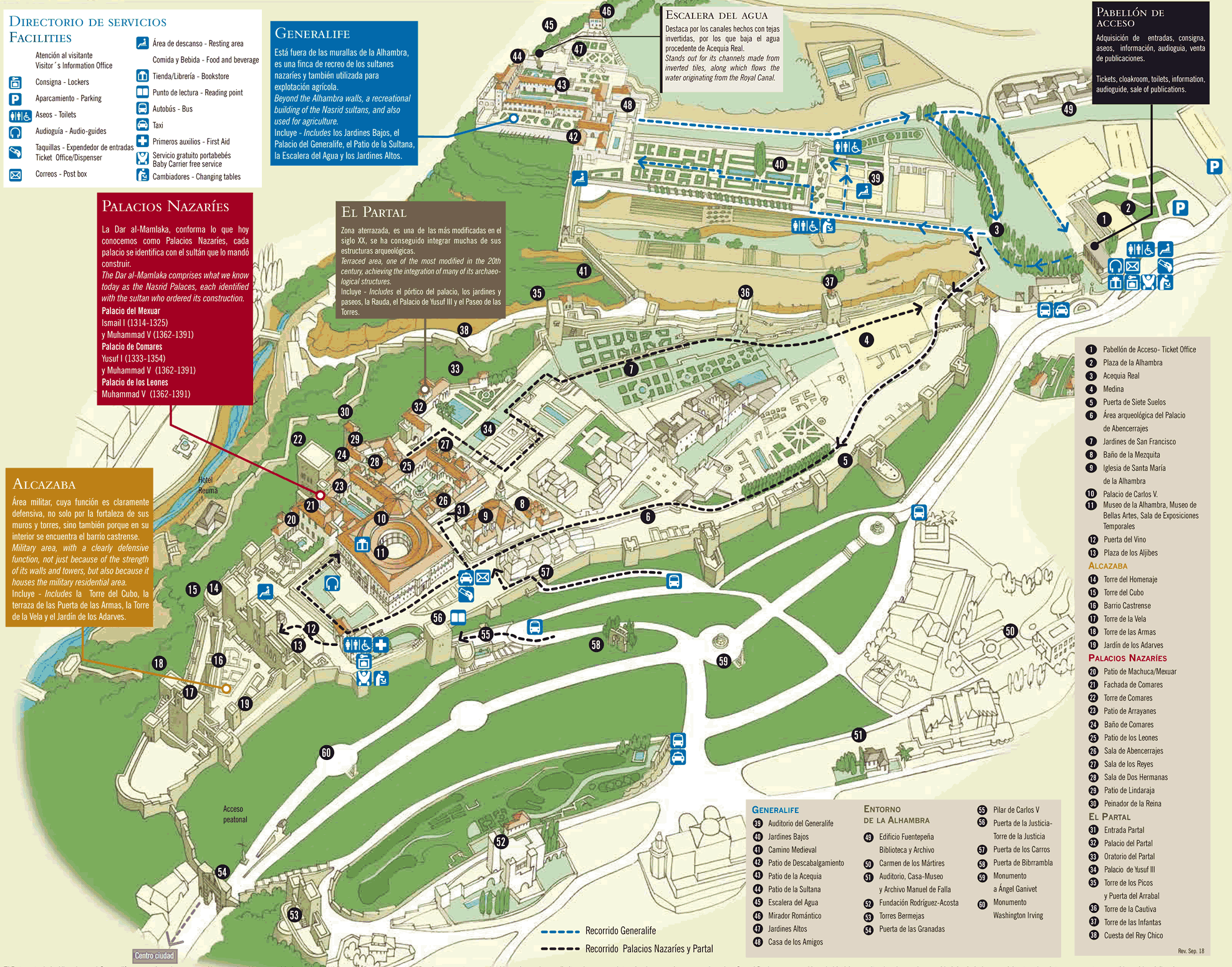

We’ll stop by these areas: the gardens and summer palace of the Generalife, the medina, the Alcazaba (fortress), the Christian Palace of Charles V, and finally the jewel, the Nasrid Palaces.
And we’ll sprinkle some history here and there. Such as generally about what this place is:
The Alhambra began as a modest hilltop fortress in the 9th century and evolved into the royal palatine city and main residence of the Nasrid emirs of Granada between the 13th and 15th centuries, before becoming a coveted symbol and “trophy palace” for the Catholic Monarchs and later Charles V. Its architecture fuses Western Islamic traditions (especially North African and earlier Andalusi forms) into a late, highly refined Nasrid style that Christian observers both admired and exoticized, while Muslim authors saw it as a culminating expression of courtly and spiritual ideals on the last frontier of al‑Andalus. (※)
The Generalife
This part of the overall Alhambra lies outside the main fortifications. The rulers of the Nasrid dynasty created this area as a summer retreat. Though the land lies right next to the fortified Alhambra, the rulers thought of it as a rural escape.
These gardens were renowned for their integration of cooling and calming water elements, cool shade in the hot summers, and aromatic and edible plants such as citrus trees, culinary and medicinal herbs, and vegetables. The formal gardens of Islamic cultures like this one in al-Andalus always symbolized paradise, as well as intimate links between the ruler, the landscape, and the divine.
Today, most of the plants in the gardens are floral rather than utilitarian. This change is a legacy of later Christian owners who wanted decoration instead of usefulness. We visited in November, so there weren’t many blooming flowers, but the lush greenery and gurgling fountains and water courses enchanted nonetheless.


One of our tour guides said that the Muslims used water in subtle, gentle ways. Water cools both literally and psychologically: the soft sound of modest fountains and soft cascades calms, conjures feelings of freshness, and invites introspection. The guide said you can tell if a fountain was added by later Christians if it throws water around boisterously.

In the buildings of the Generalife summer retreat, you can see simplicity and openness, especially to the plains of Granada below.


The Medina
The walk from the Generalife to the main Nasrid Palaces took us past these excavated ruins of the medina, or walled town. The Alhambra served as the fortified residence of the royal family and its court, but it was also a military town. Soldiers, artisans, bakers, and all the rest of the population of a complete town lived here, in service to the court.

This combination of fortification, royal residence, and supporting civilian town reminded us of La Cité de Carcassonne, at least in function.
The Alcazaba
The Alcazaba is where fortification of this hill began, at least as early as the 9th century. The founder of the Nasrid emirate, Muhammad I Ibn al-Ahmar, began the expansion of the fortress and establishment of the royal residence.
Both from the massive construction visible from below…

…and the unencumbered view over the broad landscape…

…you can appreciate the effectiveness of this stronghold. As far as we can tell, the Alcazaba was never successfully breached by attackers. The Christian monarchs of the late 1400’s couldn’t militarily vanquish the Nasrid emirate. They ultimately succeeded through prolonged siege and negotiation.
The Palace of Charles V
From the middle of the 13th century, Granada was the last remaining Muslim emirate of al-Andalus. For the next 200-plus years, the coexistence of the emirate and Catholic kingdoms was complicated, a mixture of border disputes and focused offensives, but also alliances and trade. It wasn’t until the mid-15th century did the Catholic Monarchs dedicate themselves to the removal of this last Muslim emirate from Iberia.
Finally, in 1492, the last emir, Boabdil, capitulated to Isabella and Ferdinand because Granada was militarily exhausted, politically divided, and cut off from help from the greater Islamic world.
After the defeat, Boarbdil left Granada. A famous story says that his mother rebuked him when he wept as he looked back at Granada for the last time. She’s reputed to have said that “you should weep like a woman for what you could not defend as a man.” Harsh.
After the capitulation, the Alhambra instantly became a palace complex for Isabella and Ferdinand. They transformed the mosques into churches. But their primary residence and court center were elsewhere, and they resided here only for a few months after the capitulation. Grenada became just one of their many royal cities.
It was during their time here in Granada that they gave Columbus permission and support to undertake his first voyage.
About 30 years after the departure of the Nasrids, Charles V, the grandson of Isabella and Ferdinand, ordered the construction of a massive, formal Renaissance-style palace in the middle of the Alhambra. The message was clear: All this is ours now, and our Christian kingdom has vanquished the Muslim emirate.
Ironically, Charles and his court lost interest in the project, and no one wanted to live there. The palace remained incomplete and roofless until the 20th century!
Compare the abstract coldness of the dramatic circular court with the delicacy and intimacy of the Nasrid Palaces.

The Nasrid Palaces
These are the jewels of the Alhambra.
The Court of the Myrtles was the central courtyard of the main state and throne palace of the Nasrid emirs. It functioned as both a serene, controlled garden space and as the antechamber to the Hall of the Ambassadors, where the ruler’s most formal audiences and negotiations took place.


The Hall of the Ambassadors was the main throne room. The hall is renowned for its spectacular wooden ceiling, a complex geometric composition of thousands of pieces aligning cosmic order with the ruler’s earthly authority.

The Courtyard of the Lions takes its name from the mid-14th-century fountain at its center. This part of the palace complex was the most private and intimate part of the palace. Only the family of the emir and a narrow circle of high-ranking courtiers and servants enjoyed these spaces.


The Hall of the Two Sisters, a large reception and residential hall with one of the most elaborate muqarnas domes in the Alhambra.

The Hall of the Abencerrajes, another great hall with a spectacular star‑shaped muqarnas vault, associated in later legend with the massacre of the Abencerraj family.

On the east side: the Hall of the Kings, a suite of three interconnected chambers opening off the arcade, famous for painted wooden ceilings showing courtly and possibly dynastic scenes.


There’s a small museum in the nearby Palace of Charles V, and it includes some explanation about how the artisans constructed these complex domes.


There is also a reconstruction that shows how colorful the walls and ceilings were in the time of the emirate. Imagine vivid colors on all the details in the photos of this post!

There was also stained glass, only a tiny example of which remains.

Here and there, you find evidence of the intrusion of the vanquishers of the emirate of Granada, such as the so‑called Hall of the Mocárabes / Hall of the Muqarnas, originally covered by a richly sculpted muqarnas vault and used as another important reception space.

And this very nice medieval ceiling panel.

We visited the Alhambra twice during our few days in Granada. The first encounter was with a guide, and the second was on our own so that we could wander at our own pace. We savored every minute!
Our caveat about the colossal reputation of the Alhambra is this: The Alhambra is gorgeous, fascinating, unique, exquisite, and generous. But it is also intimate and delicate. Some other palaces that we’ve had the great fortune to experience, such as Versailles and the Residenz in Munich, are colossal in the grand and showy sense. Instead, the Alhambra wraps you up in its arms and whispers!


November 2025